
4strokes are better than2
Expert
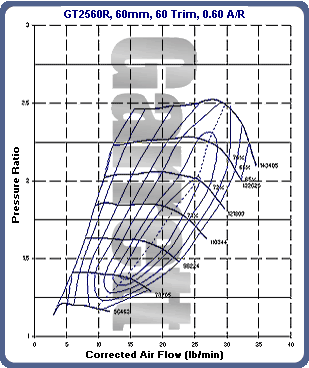
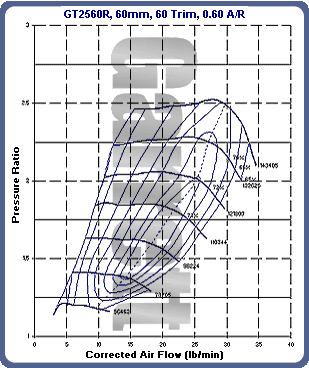
thought this would be a good topic & always wanted to learn myself.so for all the guys that know would love a basic overveiw.iam interested in a new turbo for my tvec & would like to know how to pick one for my application witch is all mountain riding & would like to know why to pick one turbo over the other & why i should use that specific turbo.iam looking to run 15-18lbs boost at 3000-5500ft.here is a couple differnt maps from differnt 2560 turbos that iam considering.





Crewchief47
Lifetime Member
- Joined
- Jan 16, 2006
- Messages
- 2,830
- Reaction score
- 32
- Points
- 1,333
- Location
- McGregor, ON Canada
- Country
- Canada
- Snowmobile
- 2008 Nytro MTX 45th
I have no information to offer except that the scaling appears to be different on the very top one, so take that into consideration.

Ted Jannetty
TY 4 Stroke God
- Joined
- Nov 24, 2003
- Messages
- 2,010
- Reaction score
- 15
- Points
- 1,198
- Location
- Waterbury Ct.
- Website
- www.jannettyracing.com
Understanding A/R
The A/R parameter has different effects on the compressor and turbine performance, as outlined below.
Compressor A/R - Compressor performance is comparatively insensitive to changes in A/R. Larger A/R housings are sometimes used to optimize performance of low boost applications, and smaller A/R are used for high boost applications. However, as this influence of A/R on compressor performance is minor, there are not A/R options available for compressor housings.
Turbine A/R - Turbine performance is greatly affected by changing the A/R of the housing, as it is used to adjust the flow capacity of the turbine. Using a smaller A/R will increase the exhaust gas velocity into the turbine wheel. This provides increased turbine power at lower engine speeds, resulting in a quicker boost rise. However, a small A/R also causes the flow to enter the wheel more tangentially, which reduces the ultimate flow capacity of the turbine wheel. This will tend to increase exhaust backpressure and hence reduce the engine's ability to "breathe" effectively at high RPM, adversely affecting peak engine power.
Conversely, using a larger A/R will lower exhaust gas velocity, and delay boost rise. The flow in a larger A/R housing enters the wheel in a more radial fashion, increasing the wheel's effective flow capacity, resulting in lower backpressure and better power at higher engine speeds.
When deciding between A/R options, be realistic with the intended vehicle use and use the A/R to bias the performance toward the desired powerband characteristic.
Here's a simplistic look at comparing turbine housing geometry with different applications. By comparing different turbine housing A/R, it is often possible to determine the intended use of the system.
Imagine two 3.5L engines both using GT30R turbochargers. The only difference between the two engines is a different turbine housing A/R; otherwise the two engines are identical:
1. Engine #1 has turbine housing with an A/R of 0.63
2. Engine #2 has a turbine housing with an A/R of 1.06.
What can we infer about the intended use and the turbocharger matching for each engine?
Engine#1: This engine is using a smaller A/R turbine housing (0.63) thus biased more towards low-end torque and optimal boost response. Many would describe this as being more "fun" to drive on the street, as normal daily driving habits tend to favor transient response. However, at higher engine speeds, this smaller A/R housing will result in high backpressure, which can result in a loss of top end power. This type of engine performance is desirable for street applications where the low speed boost response and transient conditions are more important than top end power.
Engine #2: This engine is using a larger A/R turbine housing (1.06) and is biased towards peak horsepower, while sacrificing transient response and torque at very low engine speeds. The larger A/R turbine housing will continue to minimize backpressure at high rpm, to the benefit of engine peak power. On the other hand, this will also raise the engine speed at which the turbo can provide boost, increasing time to boost. The performance of Engine #2 is more desirable for racing applications than Engine #1 where the engine will be operating at high engine speeds most of the time.
The A/R parameter has different effects on the compressor and turbine performance, as outlined below.
Compressor A/R - Compressor performance is comparatively insensitive to changes in A/R. Larger A/R housings are sometimes used to optimize performance of low boost applications, and smaller A/R are used for high boost applications. However, as this influence of A/R on compressor performance is minor, there are not A/R options available for compressor housings.
Turbine A/R - Turbine performance is greatly affected by changing the A/R of the housing, as it is used to adjust the flow capacity of the turbine. Using a smaller A/R will increase the exhaust gas velocity into the turbine wheel. This provides increased turbine power at lower engine speeds, resulting in a quicker boost rise. However, a small A/R also causes the flow to enter the wheel more tangentially, which reduces the ultimate flow capacity of the turbine wheel. This will tend to increase exhaust backpressure and hence reduce the engine's ability to "breathe" effectively at high RPM, adversely affecting peak engine power.
Conversely, using a larger A/R will lower exhaust gas velocity, and delay boost rise. The flow in a larger A/R housing enters the wheel in a more radial fashion, increasing the wheel's effective flow capacity, resulting in lower backpressure and better power at higher engine speeds.
When deciding between A/R options, be realistic with the intended vehicle use and use the A/R to bias the performance toward the desired powerband characteristic.
Here's a simplistic look at comparing turbine housing geometry with different applications. By comparing different turbine housing A/R, it is often possible to determine the intended use of the system.
Imagine two 3.5L engines both using GT30R turbochargers. The only difference between the two engines is a different turbine housing A/R; otherwise the two engines are identical:
1. Engine #1 has turbine housing with an A/R of 0.63
2. Engine #2 has a turbine housing with an A/R of 1.06.
What can we infer about the intended use and the turbocharger matching for each engine?
Engine#1: This engine is using a smaller A/R turbine housing (0.63) thus biased more towards low-end torque and optimal boost response. Many would describe this as being more "fun" to drive on the street, as normal daily driving habits tend to favor transient response. However, at higher engine speeds, this smaller A/R housing will result in high backpressure, which can result in a loss of top end power. This type of engine performance is desirable for street applications where the low speed boost response and transient conditions are more important than top end power.
Engine #2: This engine is using a larger A/R turbine housing (1.06) and is biased towards peak horsepower, while sacrificing transient response and torque at very low engine speeds. The larger A/R turbine housing will continue to minimize backpressure at high rpm, to the benefit of engine peak power. On the other hand, this will also raise the engine speed at which the turbo can provide boost, increasing time to boost. The performance of Engine #2 is more desirable for racing applications than Engine #1 where the engine will be operating at high engine speeds most of the time.
Ted Jannetty
TY 4 Stroke God
- Joined
- Nov 24, 2003
- Messages
- 2,010
- Reaction score
- 15
- Points
- 1,198
- Location
- Waterbury Ct.
- Website
- www.jannettyracing.com
compressor maps

Need for Speed 2
TY 4 Stroke Junkie
ted my head hurts just trying to absorb all this . how many years did you spend in college?
Ted Jannetty
TY 4 Stroke God
- Joined
- Nov 24, 2003
- Messages
- 2,010
- Reaction score
- 15
- Points
- 1,198
- Location
- Waterbury Ct.
- Website
- www.jannettyracing.com
Need for Speed 2 said:ted my head hurts just trying to absorb all this . how many years did you spend in college?
Just a few, I copied and pasted it from Garrett Tech manual.
4strokes are better than2
Expert
thanks ted i saved it to my computer it mite take me a few days to get the full understanding of it. 

Thomas800
Pro
- Joined
- Dec 17, 2004
- Messages
- 163
- Reaction score
- 1
- Points
- 466
- Location
- Fort St. John B.C. Canada
- Website
- www.snowmobiledragsters.com
Here is link that you may enjoy. The information is basically the same, just worded differently.
http://www.mrcontrols.com/primers/sizing.htm
http://www.mrcontrols.com/primers/sizing.htm

Links to calculators, map plotters, map info in this thread:
http://www.ty4stroke.com/viewtopic.php?t=43228
http://www.ty4stroke.com/viewtopic.php?t=43228
4strokes are better than2
Expert
thanks guys real great stuff this is goin to take me some time to absorbe all this but its fun learning. :exc:
:exc:Similar threads

- Replies
- 8
- Views
- 2K


- Replies
- 18
- Views
- 6K

-
This site uses cookies to help personalise content, tailor your experience and to keep you logged in if you register.
By continuing to use this site, you are consenting to our use of cookies.