
Tuco
Extreme
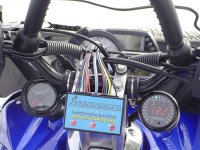
Got the S/C installed. It took about 20 hours for the install but the next one could be done in less time. Added 8.7 grams per weight and a 47-51 helix. Riding at close to 11000 ft. it was turnin 9800-10200 rpm and a 60 mph track speed up the hills. The fuel controller is nice and very simple to adjust with the wideband O2 gauge. http://www.zippyvideos.com/3864246453000506/1-2-06_cottonwood/]1-2-06 cottonwood.wmv
ken_climb
TY 4 Stroke Junkie
Sounds nice and shnappy! Nice!

Freak
TY 4 Stroke Junkie
Like the wideband. Where do you get those and how much?

- Joined
- Apr 17, 2003
- Messages
- 5,529
- Reaction score
- 1,393
- Points
- 2,003
- Location
- Menno, SD
- Website
- www.ulmerracing.com
- Country
- USA
- Snowmobile
- 2014 Yamaha SR Viper LTX, 2014 Yamaha SR Viper RTX SE, 2015 Yamaha SR Viper MTX SE 162 (turbo), 2015 Yamaha SR Viper MTX SE 153
- LOCATION
- Menno, SD
- WEBSITE
- www.ulmerracing.com
The only thing I don't like about that wideband air/fuel ratio gauge is that it's very hard to read when any hint of daylight is on the gauge.
My recommendation is the Innovate Motorsports XD-1 Standalone gauge. Much better for the $$$.
http://www.innovatemotorsports.com/products/xd1.php
My recommendation is the Innovate Motorsports XD-1 Standalone gauge. Much better for the $$$.
http://www.innovatemotorsports.com/products/xd1.php
Tuco
Extreme
The wideband is a WMS, I got it through MPI. I think it was about 450 with everything needed to install. It works pretty good I dont stare at it much so the light issue doesnt bother me.
Bossman
Expert
The Innovative gauge is $400 and I thought that was expensive. Ouch!
SoCoRX1
TY 4 Stroke Guru
nice to hear you got it running Josh. I am going to order my MPI Blower soon for my RX probably next week


PwdrNut
Lifetime Member
- Joined
- Jan 16, 2005
- Messages
- 136
- Reaction score
- 1
- Points
- 566
- Location
- Salida, CO
- Website
- www.haboost.com
I recently installed this gauge to replace my Autometer. The digital display is easy to read.
http://www.urdusa.com/product_info.php? ... fe90f6333e
http://www.urdusa.com/product_info.php? ... fe90f6333e
nitrousmudbogger
Extreme
No offence but it says on the vid that your running 12.6:1 and thats too rich at idle

EDITED TO ELIMINATE ANY CONFUSION
Short version:
"In most cases the target A/F ratio for naturally aspirated engines will be between 12.8:1 and 13.2:1 whereas supercharged, turbocharged, and nitrous-injected engines will like a richer mixture between 11.5:1 and 12.5:1"
"Due to the low port velocity and frictional losses Idle mixtures are typically set at a fuel ratio of 12.25:1. Your motor will idle at stoichiometry (14.7:1) or less than stoichiometry but this is very near misfiring and if operating temperatures are not stabilized at a high level the motor will die. For example, operational fluid temperatures can vary from 150 degrees Fahrenheit to 250 degrees Fahrenheit and inlet air temperatures can easily vary 100 degrees Fahrenheit. These variations in temperature all necessitate different mixture requirements so it is far better to keep the fuel ratio in the 12.25:1 region to preserve idle quality and off-idle responsiveness"
"There is no magical, absolute, digitized answer to developing your applications fuel requirements. You must drive your machine and a considerable amount of judgement must be placed in such areas as cold start, warm-up, acceleration fueling, idle quality, and driveability. Each motor is different and the calibration will be only as good as the effort you put into it. Much subjective decision making will take place and the A/F ratio meter will not provide you all the answers. Stop watches, elapsed times, lap times and your own opinions as a tester are as equally valid"
How's that Ted..........
Short version:
"In most cases the target A/F ratio for naturally aspirated engines will be between 12.8:1 and 13.2:1 whereas supercharged, turbocharged, and nitrous-injected engines will like a richer mixture between 11.5:1 and 12.5:1"
"Due to the low port velocity and frictional losses Idle mixtures are typically set at a fuel ratio of 12.25:1. Your motor will idle at stoichiometry (14.7:1) or less than stoichiometry but this is very near misfiring and if operating temperatures are not stabilized at a high level the motor will die. For example, operational fluid temperatures can vary from 150 degrees Fahrenheit to 250 degrees Fahrenheit and inlet air temperatures can easily vary 100 degrees Fahrenheit. These variations in temperature all necessitate different mixture requirements so it is far better to keep the fuel ratio in the 12.25:1 region to preserve idle quality and off-idle responsiveness"
"There is no magical, absolute, digitized answer to developing your applications fuel requirements. You must drive your machine and a considerable amount of judgement must be placed in such areas as cold start, warm-up, acceleration fueling, idle quality, and driveability. Each motor is different and the calibration will be only as good as the effort you put into it. Much subjective decision making will take place and the A/F ratio meter will not provide you all the answers. Stop watches, elapsed times, lap times and your own opinions as a tester are as equally valid"
How's that Ted..........
Attachments

Ted Jannetty
TY 4 Stroke God
- Joined
- Nov 24, 2003
- Messages
- 2,010
- Reaction score
- 15
- Points
- 1,198
- Location
- Waterbury Ct.
- Website
- www.jannettyracing.com
Great Post Hammer, but All this only applys to naturally aspirated engines.
A boosted engines will burn down at 12.7:1 A/F and will not make max power, We see max power at about 12.0:1 to 12.2:1, this gives us more reliable and more consistant results.
Still after all that, there are still exceptions to the rule I have had engines make max power at 10.8:1 for reasons due to camshaft overlap, compression ratio, combustion chamber efficiency, ignition variables, fuel types etc.
I hope this information is helpful I don't want to see anyone burn a piston because they are too lean.
A boosted engines will burn down at 12.7:1 A/F and will not make max power, We see max power at about 12.0:1 to 12.2:1, this gives us more reliable and more consistant results.
Still after all that, there are still exceptions to the rule I have had engines make max power at 10.8:1 for reasons due to camshaft overlap, compression ratio, combustion chamber efficiency, ignition variables, fuel types etc.
I hope this information is helpful I don't want to see anyone burn a piston because they are too lean.
Similar threads
- Replies
- 9
- Views
- 1K


- Replies
- 17
- Views
- 5K

- Replies
- 0
- Views
- 2K
-
This site uses cookies to help personalise content, tailor your experience and to keep you logged in if you register.
By continuing to use this site, you are consenting to our use of cookies.